Technical overview
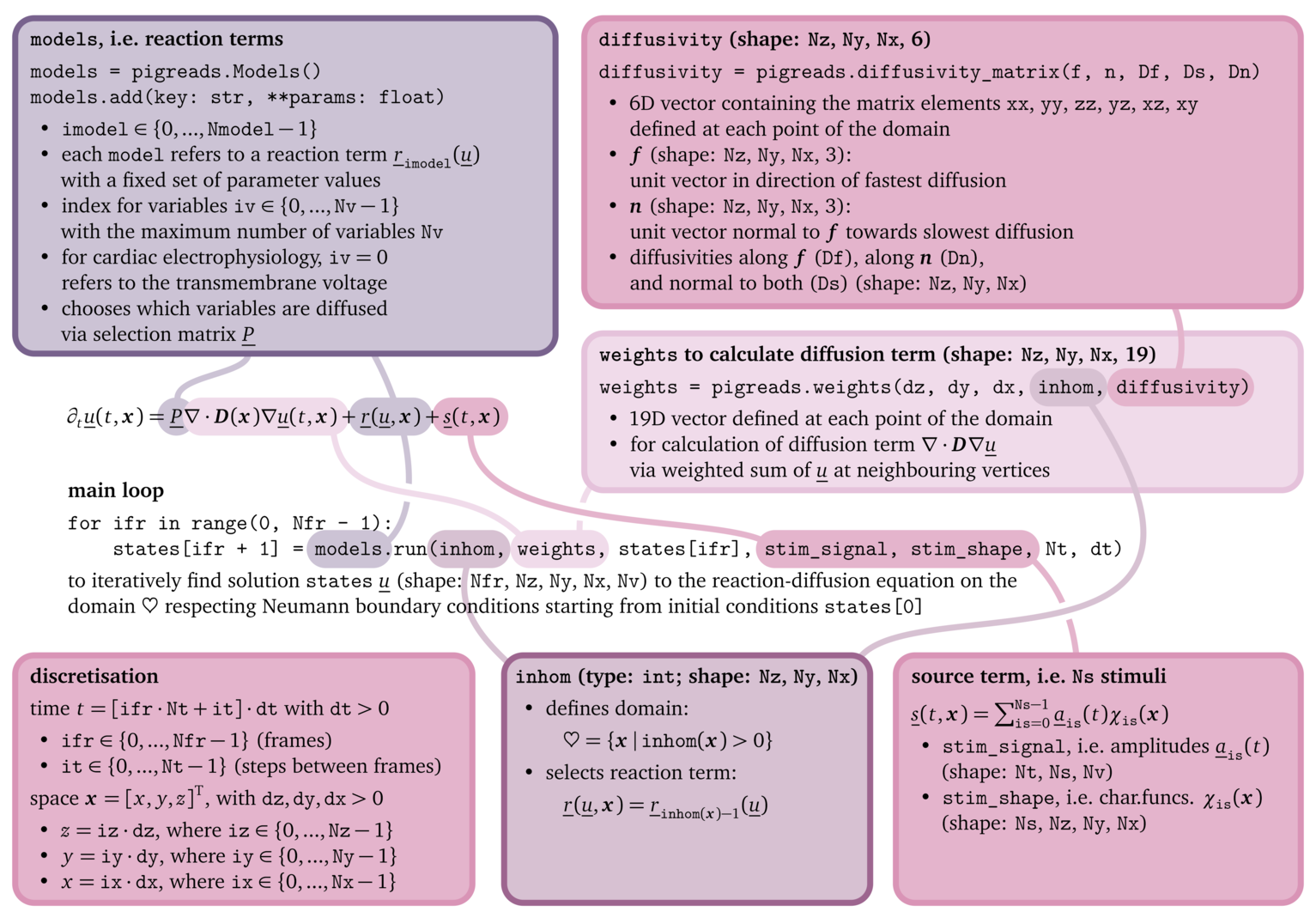
Pigreads organises simulation components around three objects: an
instance of the class Models that defines local reaction terms, an
array inhom that defines the domain and which model to use where,
and an array states holding all state variables on a uniform
Cartesian grid, see also the above figure.
Numerical choices are deliberately simple: finite-difference stencils for spatial derivatives and explicit forward-Euler time stepping. Supported capabilities include 0D-3D grids, no-flux and periodic boundary conditions, spatially varying anisotropic diffusivity and reaction terms, and source terms.
Diffusion and reaction kernels run in OpenCL on the selected GPU/CPU device; Python performs setup, parameter changes, and in- and output while results remain accessible as NumPy arrays for analysis and plotting, for instance using Matplotlib or PyVista.